
How Do Black and Grey Realism Tattoos Age?

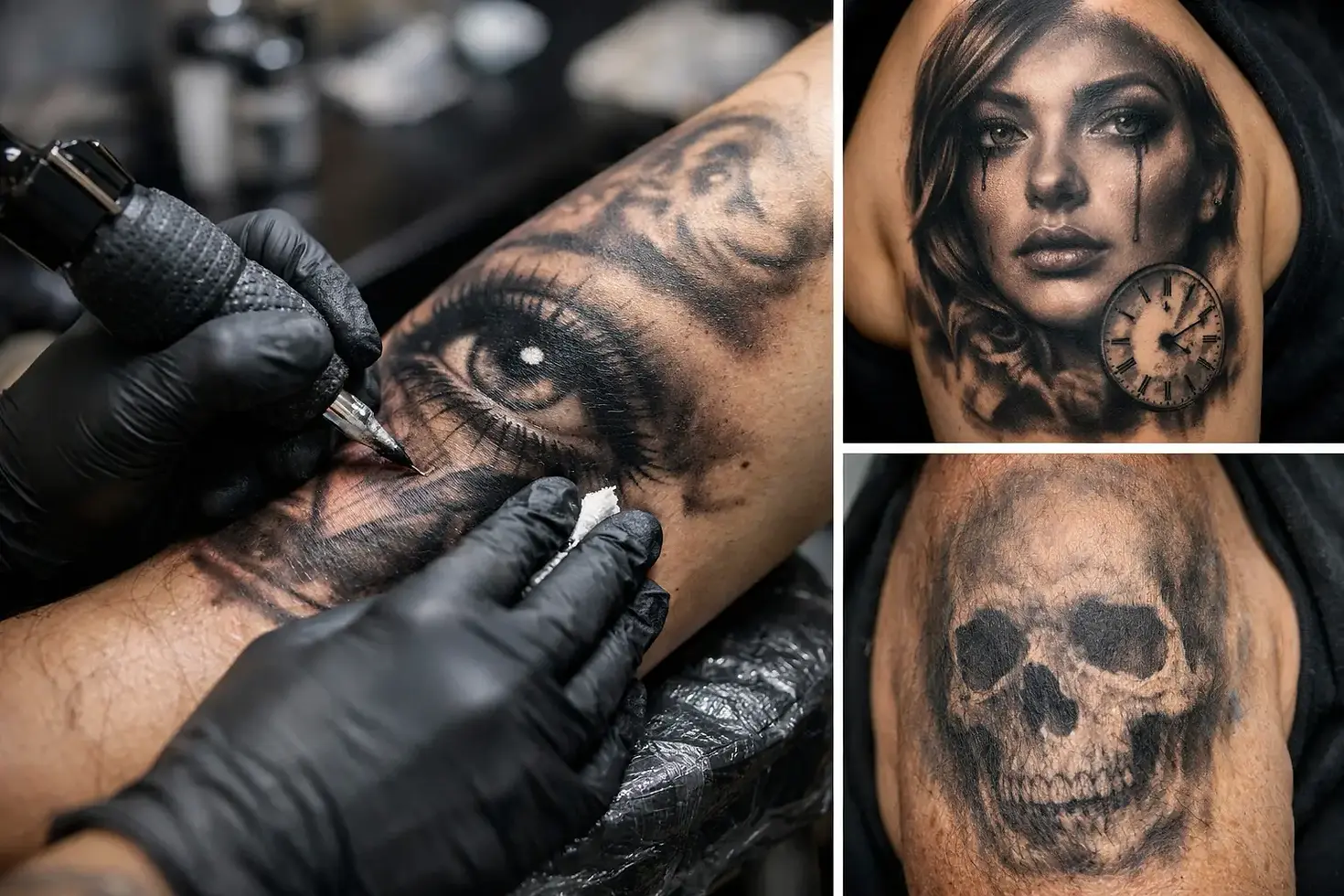
A black and grey realism tattoo can look incredibly sharp when it’s fresh - smooth shading, soft contrast, fine detail and depth that reads almost like a photograph in skin. The real question is how do black and grey realism tattoos age once that initial crispness settles and the body starts doing what bodies do. If you’re choosing this style, especially for a portrait, memorial piece or something deeply personal, you want the honest answer rather than sales talk.
The honest answer is this: black and grey realism can age very well, but only when the design, application, placement and aftercare all work together. No tattoo stays exactly as it looked on day one. Skin changes. Pigment settles. Edges soften. The goal is not to pretend ageing does not happen. The goal is to build a tattoo that still reads well, still feels intentional and still carries the weight it was meant to carry years down the line.
How do black and grey realism tattoos age over time?
Compared with colour realism, black and grey often has an advantage in longevity. Black pigment tends to hold more reliably in the skin, and well-built grey shading can mature in a way that still looks natural rather than patchy. That said, realism is one of the more demanding styles when it comes to ageing because it relies on subtle transitions, delicate values and precise detail. If those things are poorly planned at the start, time exposes it.
A strong black and grey realism tattoo usually softens rather than falls apart. The darkest areas remain the structure. Mid-tones settle. Very light tones may become fainter over the years. Fine textures such as pores, tiny hairs and micro details can blur together if they were packed too tightly in the first place. This is why experienced realism artists do not just copy a photo. They interpret it for skin.
That matters more than most people realise. Skin is not paper. It moves, stretches, heals and ages. What looks impressive as a digital mock-up can become muddy as a tattoo if there is not enough contrast, enough breathing room or enough understanding of how the image will heal.
What makes a black and grey realism tattoo age well?
First, contrast. This is the backbone of longevity. A realism tattoo with proper darks, readable mid-tones and controlled highlights will keep its shape for longer because the image has a clear value structure. If everything sits in a similar grey range, it may look smooth on day one but flat and faded later.
Second, scale. Tiny realism tattoos can work, but there is a limit. A small portrait with dense detail has less room to age gracefully than a larger piece with space between features and transitions. Eyes, lips, hair texture and facial contours all need enough skin to live in. When a design is forced too small, the detail does not stay detail for long.
Third, placement. Areas with less friction and more stable skin often hold detail better. The outer upper arm, thigh, calf and upper back generally age more predictably than fingers, ribs, feet or hands. It does not mean difficult placements should never be tattooed. It means the design should respect the area. A highly detailed realism piece on a hand is going to face a different ageing process from one on the upper arm.
Fourth, technical application. If the black is not solid, if the greys are patchy, or if the artist overworks the skin trying to force softness, the tattoo can heal unevenly. Black and grey realism requires control. Smooth shading is not about going harder. It is about knowing exactly how much to put where.
Why some realism tattoos fade better than others
Two black and grey tattoos can be the same age and look completely different. One still reads clearly. The other looks washed out. Usually that comes down to planning and discipline rather than luck.
The better-healed tattoo is often the one that was designed with ageing in mind. That means stronger anchor points in the dark areas, less reliance on ultra-light detail, and a composition that still makes sense when the skin naturally softens the image. Good realism artists simplify where they need to. They know which detail matters and which detail is only there for the first photo.
This is especially important for portraits and memorial tattoos. People often bring in emotional reference images and want every tiny feature copied exactly. We understand that instinct. But if the goal is a tattoo that lasts, not just a fresh tattoo that impresses for a month, some translation is necessary. It has to be right, or we do not do it.
The biggest ageing risks in black and grey realism
The most common problem is not that the whole tattoo disappears. It is that it loses clarity. Features that once looked sharp begin to merge. Soft backgrounds can swallow the main subject. Light grey passages can drop away until only the dark sections remain doing the visual heavy lifting.
Sun exposure is a major factor. Repeated UV damage breaks down how crisp the tattoo appears and can make black and grey look dull faster than it should. If you spend a lot of time outdoors and never protect the area, you are effectively speeding the process up.
Poor aftercare can also affect how the tattoo settles in the first place. Picking, over-moisturising, friction from clothing and ignoring healing advice all increase the chance of patchy results. Then there is the long game - dry skin, regular abrasion and general skin ageing all play a part.
Weight change, muscle gain, pregnancy and general body changes can alter how any tattoo sits in the skin. Realism can be less forgiving here because the image depends so much on proportion and subtle shape. Again, this does not mean avoid the style. It means place and design it intelligently.
How do black and grey realism tattoos age on different skin tones?
They can age beautifully across a wide range of skin tones, but the approach should never be copy-and-paste. On deeper skin tones, contrast and readability need especially careful planning. Very light grey tones may not show in the same way they do on pale skin, so the tattoo must be built to suit the person wearing it.
This is one reason consultation matters. A realism design should be tailored not only to the reference image, but to the skin itself. Undertone, texture, scar tissue, sun exposure and placement all influence the final result. Good work is not about forcing the same formula on everyone. It is about making choices that give the tattoo the best chance to heal and age properly.
Can touch-ups help?
Yes, but they are not a substitute for quality from the start. A touch-up can restore contrast, reinforce key areas and bring back readability where the tattoo has naturally softened over time. What it cannot do is fix a weak foundation completely.
If a realism tattoo was made too small, too light or too cluttered, adding more years and more ink does not always solve the core issue. Sometimes less is more. Sometimes the right answer is leaving it alone until it genuinely needs refinement rather than chasing a permanently fresh look.
A well-done black and grey realism piece should not need constant maintenance. It should settle, mature and still make sense on the skin without demanding endless rescue work.
What should you ask before getting one?
If you are thinking seriously about this style, ask to see healed work, not just fresh tattoos under studio lighting. Fresh tattoos always look punchier. Healed results tell you whether the artist understands longevity.
You should also ask whether your idea suits black and grey realism at the size and placement you want. A decent artist will tell you if the concept needs to go larger, simpler or darker. That is not upselling. That is protecting the result.
For clients in West Sussex and along the South Coast, this is where a private, design-led studio experience makes a difference. At Kartel Collective, the work starts with the right conversation. No rushing. No distractions. If a design needs adjusting to age better, that is part of the process.
The long view matters more than the fresh photo
Black and grey realism is one of the most rewarding tattoo styles when it is handled properly. It carries emotion well. It suits portraits and memorial work beautifully. It can look refined, serious and timeless. But it is not a style to choose casually, and it is not a style to judge only by how it looks on the day it is done.
The better question is not whether it ages. Every tattoo ages. The better question is whether it ages with dignity, clarity and intent. If the artist knows how to build for skin, if the design has enough space and contrast, and if you look after it properly, black and grey realism can hold its impact for years. Choose the work with the healed version in mind, and you will usually make the better decision.


Comments